
Interview with Carlien Scheele

Knowledge, Power, Health, Money …
Gender equality in Europe

The European Institute for Gender Equality (EIGE), based in Vilnius, Lithuania, monitors progress on gender equality within the European Union. The director of the institute, Carlien Scheele, reports on which countries are leading the way.

Carlien Scheele, Director of the European Institute for Gender Equality (EIGE) in Vilnius, Lithuania

DM Mrs Scheele, you are publishing the gender equality index within the EU. Which areas do you analyse?
Carlien Scheele Our Gender Equality Index covers six main areas of life: work, health, knowledge, money, time and power. In these core domains we measure the progress of gender equality in the EU and the Member States to provide visibility to areas that need improvement and support policy makers to design more effective gender equality measures. Additionally, we also assess the state of violence against women in the EU with available comparable data.
DM What is the current situation in the EU: Which countries and which areas are particularly noteworthy in terms of gender equality?
Carlien Scheele As of 2023, the EU sits at 70.2 points out of 100 – where 100 indicates full gender equality. This is the best score since the inception of our Index in 2010. Sweden, the Netherlands and Denmark continue to lead the way in the Index – as they have done over a decade.
Yet, either their progress has plateaued, or they have suffered a slip in points – as we see in countries such as Finland or France. This clearly shows that gains cannot be taken for granted. They need to be anchored and supported by measures to maintain progress.
On the other end, we see countries like Italy, Portugal and Malta who despite scoring below the EU average, have made vast improvements in gender equality in the last 10 years. So, when countries put measures in place, progress is accelerated.
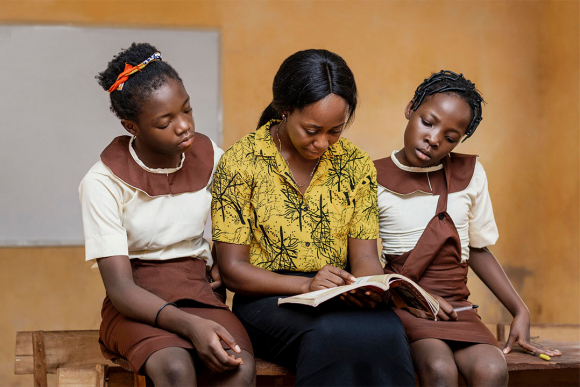
Empowering girls through education: unlocking their potential for a brighter future

Women globally make up over 70 per cent of workers in health, including those working in care institutions

DM What is „gender-based“ violence?
Carlien Scheele Gender-based violence is both a cause and a consequence of gender inequality. Gender-based violence is any type of violence based on someone’s gender from physical to emotional to financial to reproductive violence. While anybody can be a victim, women are overwhelmingly the victims.
As far as our support for the implementation of the Istanbul Convention, EIGE will continue to monitor, analyse, and review the impact of legislation and policy relevant to GBV from a gender perspective and inform of Istanbul Convention compliance requirements. You can find more information on our role in supporting the implementation of Istanbul Convention here.

DM What happens to the data you collect? Does it become recommendations for policy makers?
Carlien Scheele EIGE collects and analyses data on gender equality with an intersectional perspective to help policy makers design measures that are inclusive, transformative and promote gender equality in all areas of life. Our data are often the basis for or inspiration for ‘Council Conclusions’ for the Council (we work closely together with the 6 months rotating EU Presidencies and produced for example a report on ‘financial independence’ for the Belgian Presidency, which led to Council Conclusions where EIGE data were integrated. Our data also regularly get referenced in reports or documents produced by the European Commission or the European Parliament.

In 2021, around 28.2 per cent of all management positions worldwide were held by women, compared to 23.6 per cent in 1991. This means that progress over the last 30 years has not been significant

DM Thank you for this interview.

Das Europäische Institut für Gleichstellungsfragen (EIGE) ist eine EU-Agentur, die unabhängige Forschung zur Gleichstellung der Geschlechter in der Europäischen Union betreibt. Es ist das Wissenszentrum der EU zum Thema Geschlechtergleichstellung. Durch die Bereitstellung zuverlässiger und politikorientierter Daten und Informationen unterstützt es die EU und ihre Mitgliedstaaten dabei, die Gleichstellung der Geschlechter zu fördern. Das EIGE wird von der Europäischen Kommission finanziert, das jährliche Budget beläuft sich auf rund 9 Millionen Euro.

CONTACT
The European Institute for Gender Equality (EIGE)
Press: Georgie Bradley
Email: georgie.bradley@eige.europa.eu
Tel.: +370 6 982 7826