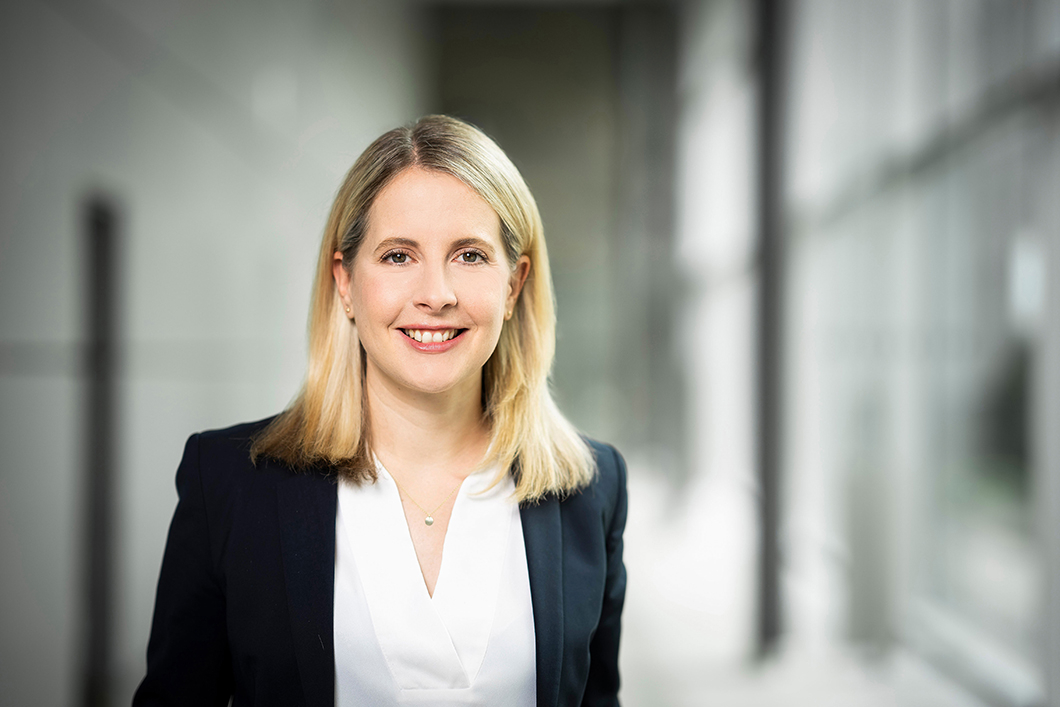
Interview with Verena Hubertz, Federal Minister for Housing, Urban Development and Construction
“Tempo, technology and tolerance”.
How to make the construction boom in Germany a success
22.09.2025
Verena Hubertz was born in Trier in 1987. After studying Business Administration, she founded an international, award-winning app-based cooking start-up. In 2021, she was elected Member of the German Bundestag for the constituency of Trier and served as Deputy Chair of the parliamentary group in the areas of economics, construction and housing, tourism, and climate and energy. Since 6 May 2025, she has been Federal Minister for Housing, Urban Development and Construction.
Germany has a shortage of hundreds of thousands of homes, including social housing. The new federal government aims to finally turn the tide in housing construction. Diplomatisches Magazin spoke to Federal Minister of Construction Verena Hubertz about this.
DMMinister Hubertz, when you took office in May, you said: ‘Building and housing is the social issue of our time. There are many problems to be solved here.’ What are the most pressing challenges?
Verena Hubertz, Federal Minister of Construction
There are quite a few challenges in housing construction. But in a nutshell: we are building too little and we are building too expensively. When I took office, I spoke of the three Ts: tempo, technology and tolerance. We need these to get the housing market moving again. In addition to greater speed, the first of these is technology. New processes can save costs. Serial construction offers incredible potential here. When I buy a car, the components are prefabricated, standardised and produced on a large scale. This is also possible in house construction. And we need tolerance. Without redensification, even in our own neighbourhoods, we will not be able to solve the housing problem, especially in large cities.
DMWhat has been achieved so far?
Verena Hubertz, Federal Minister of Construction
We have set ourselves a lot of goals in the coalition agreement to improve people’s housing situation. We have kick-started construction and already passed the budgets for 2025 and 2026 through the cabinet. And there is a lot in there for housing construction. In addition to record funding for social housing, more than 11 billion euros from the new special fund for infrastructure and climate neutrality will also go towards housing construction. We are also working on simplifying our housing construction subsidy programmes. I want to streamline and simplify them. In future, there will only be one programme for new construction and one programme for renovation. Good coexistence also means better coexistence through smart urban development. That is why we are doubling the funds for urban development within this legislative period to more than 1.5 billion euros per year.
DMYou have announced that you will provide 23.5 billion euros for social housing construction by 2029. Spread across 16 federal states, however, that is only a drop in the ocean, isn’t it?
Verena Hubertz, Federal Minister of Construction
No, these are investments on an unprecedented scale. Social housing is a very important pillar of affordable living. The provision of record funds is a clear signal: the federal and state governments are investing jointly in social cohesion. The number of social housing units is falling. I want us to reverse this trend. And that can only be done with a lot of money, among other things. That is why the federal states are also increasing their funding by at least the same amount. So we are talking about around 50 billion euros that will flow into social housing promotion over the next few years. And very importantly, the funds will also be used. In many federal states, applications from investors and builders significantly exceed the available funding opportunities. So there is a lot going on here.
DMWhat is the holdup with the announced construction boom?
Verena Hubertz, Federal Minister of Construction
The construction boom has already been approved by the cabinet and is now being debated in the German Bundestag. It was very important to me that we tackle this quickly. The construction boom will enable municipalities to build housing much more quickly. It can and should act as a powerful lever that can be used according to clear rules: every construction project needs the approval of the local authority; without it, nothing can happen. The local authority can also involve its citizens in the decision-making process if this seems appropriate to gain support for the construction project. Where it sometimes took me five years to draw up a development plan in the past, this can now be done in two months. This is a huge step forward. Incidentally, this applies not only to housing construction, but also to daycare centres and schools. I am very confident that local authorities will make use of the construction boost.
The regulatory changes proposed by the Federal Ministry of Construction are intended to be a game changer for creating more living space in the shortest possible time
Construction costs have increased due to higher prices for building materials, energy and labour
DMWhat is the National Urban Development Policy all about?
Verena Hubertz, Federal Minister of Construction
For almost 20 years, the National Urban Development Policy has been an instrument for supporting cities and municipalities in their structural change and integrated urban development. We work closely with the federal states and local authorities at the federal level. Whether it’s greening cities, revitalising local trade or connecting people in their neighbourhoods, the focus is on better coexistence. After all, cities that are ready for the future are also home to citizens who are ready for the future. Ultimately, everyone benefits from this, which is why politicians, administrators, civil society, science and business are working together in this process. At our annual federal congress in Rostock this year, current approaches to urban development will be discussed under the theme: ‘Social. Productive. Green – well-designed neighbourhoods’.
DMMinister Hubertz, thank you very much for this interview.
Interview: Marie Wildermann
National Urban Development Policy The 18th Federal Congress on National Urban Development Policy, entitled ‘Social – Productive – Green: Well-Designed Neighbourhoods’, will take place from 15 to 17 September 2025 at the StadtHalle Rostock. The event will focus on cooperative neighbourhood development and the exchange of ideas for sustainable urban design. Representatives from politics, administration, academia, professional practice and civil society will discuss forward-looking strategies for designing urban and rural areas.
CONTACT Federal Ministry of Housing, Urban Development and Construction Krausenstr. 17-18, 10117 Berlin